
A music studio ran two 8 TB SSD sets on PCIe cards inside a Mac Pro, each set striped as RAID 0 in SoftRAID. Between them they held the studio’s whole catalogue. After a macOS Big Sur update, one of the sets stopped being recognised by the RAID setup. The other was taken out of the RAID and carried on working. The studio had already been to the manufacturer, OWC, and got no data back.


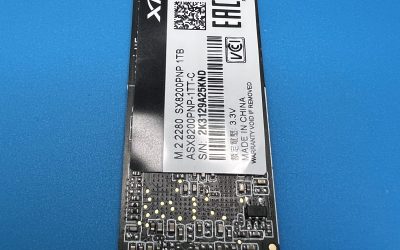
The failed set was four OWCS3DN3P2T20 OWC Aura P12 Pro 2.0 TB M.2 NVMe SSDs, all hosted on an OWC Accelsior 4M2 PCIe 3.0 M.2 NVMe SSD RAID card. RAID 0 has no fault tolerance, so every one of the four was needed.


On the bench
SSDs are handled carefully: powered up repeatedly in a faulty state, they can lose data for good. All four were imaged sector by sector before anything else, and we got good images of all four. From the images the array was confirmed as RAID 0.

The stripe used an unusual configuration to stitch the four members together.


The array itself was logically damaged. Rebuilt, it showed nothing at all — as if everything had been deleted. That turned the job into a deleted-data recovery as well, with post-processing of the RAID 0 volume to get to a working HFS+ partition.


What came back
100% of the directories in the root of the volume: 198,942 folders and 4,052,910 files, 4.4 TB. Because the files had come back as deleted data, we spot-checked video, image and .wav audio files; headers were good and everything opened as expected. No physical work was needed on the SSDs, so the four drives and the card went back with the new drive, in the condition they arrived.
OWC Accelsior 4M2 · 4 × OWC Aura P12 Pro 2.0 TB (OWCS3DN3P2T20) · SoftRAID RAID 0 · logical damage, deleted data · HFS+ · virtual RAID reconstruction
Can you recover just one SSD from a RAID 0?
Not on its own. A stripe spreads every file across all members, so one disk holds fragments, not files. We need the full set.
My RAID vanished after a macOS update. What should I do?
Stop. Don’t recreate or initialise the array, and don’t keep powering the SSDs up to try again. Each attempt risks the data that is still there. RAID 0 is for scratch and non-critical files; working projects belong on RAID 10 with a separate backup.