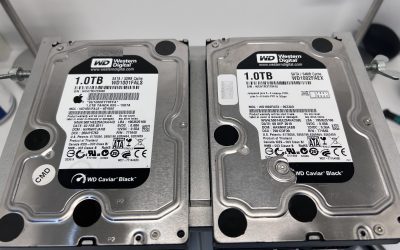
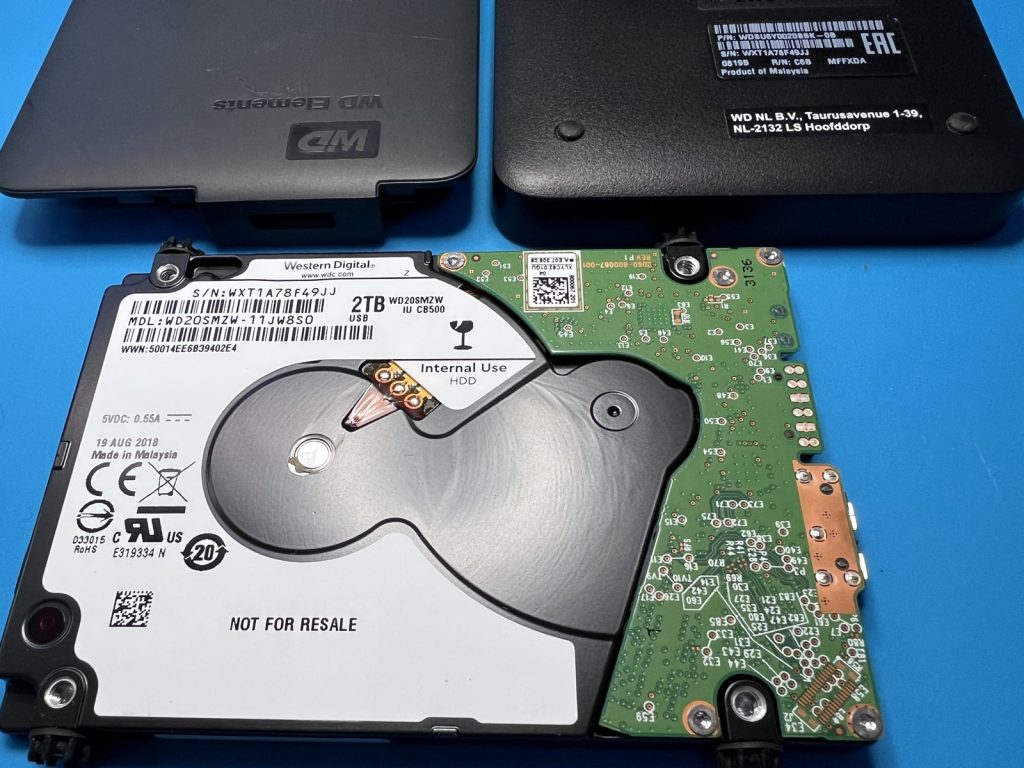
A 2 TB WD Elements portable came in from a film and photography business. It still spun up, but the Mac would no longer mount it and crashed whenever it was plugged in, ever since the Mac had gone to sleep with the drive attached and it was never ejected properly.
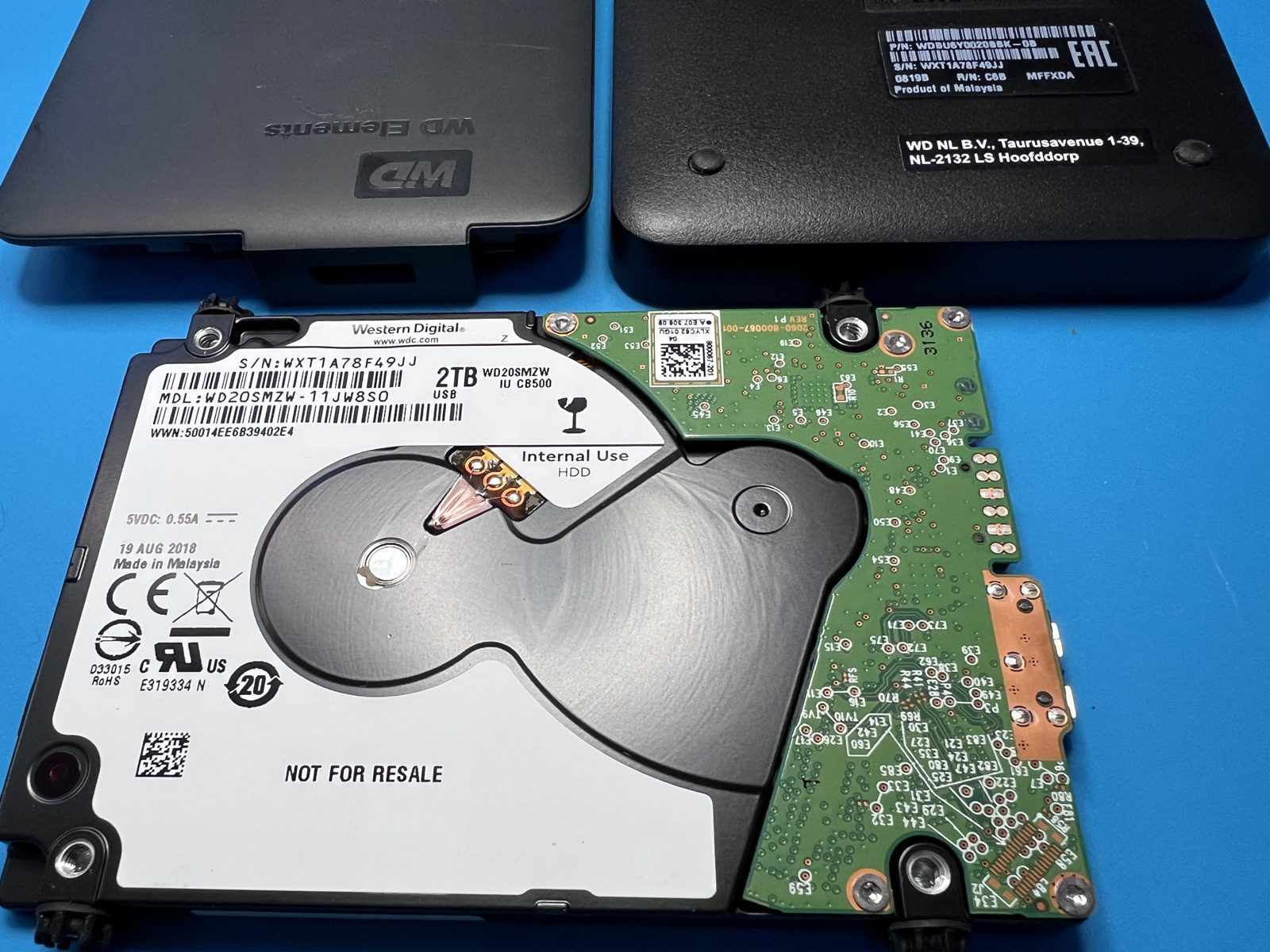
Inside the housing is a WD20SMZW-11JW8S0, a 2.5-inch drive with the USB port on its own board, about three years old. The fault was not the file system or the unsafe eject: the read/write heads had gone weak, and a drive that struggles to read its own sectors is what a Mac reports as a disk it cannot mount.
On the bench
We removed the USB board and fitted a SATA board carrying this drive’s own ROM, so the PC-3000 could work with it as a normal SATA drive. The ID screen showed ROM and service area readable, four heads, no hardware encryption.
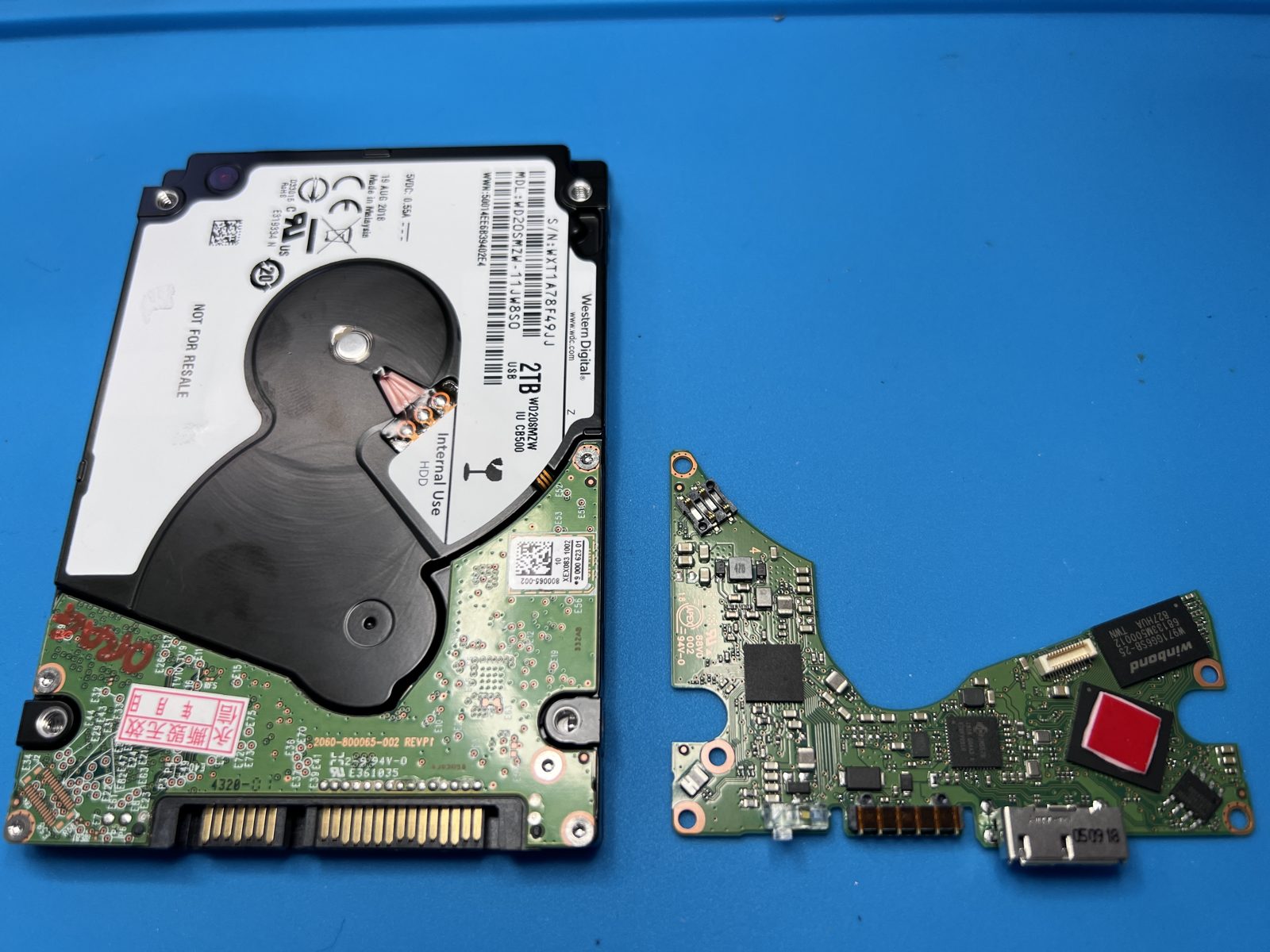
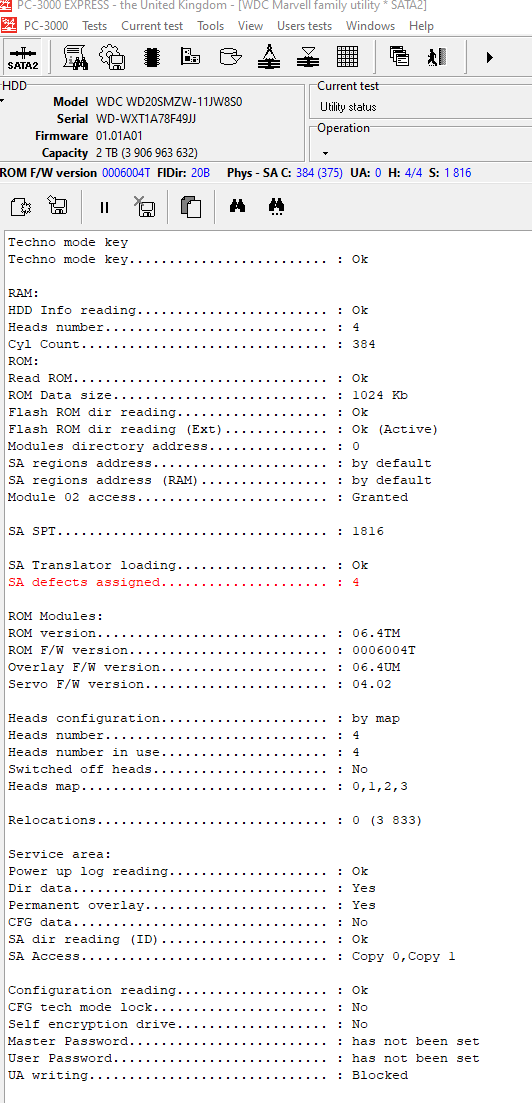
A first pass with the original heads reached 98.02% before the heads became the limit. We quoted for a matching donor and a head-stack replacement, the customer gave the go-ahead the same morning, and a second pass with the new heads took the image to 99.89%.
What came back
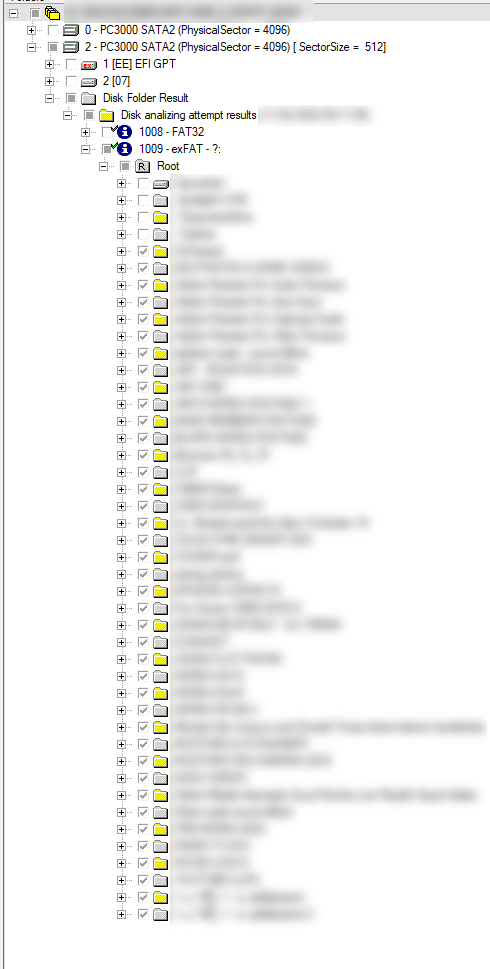
PC-3000 Data Extractor brought up the GPT partition and its exFAT volume: 241 folders and 12,126 files totalling 1192.19 GB. Thirteen files (2.69 GB) could not have every sector read; these were separated out and supplied alongside the good data, as they often still open. A few empty root folders were left out.
In the lab on the Thursday, diagnosed on the Friday, recovered the following Tuesday and collected by UPS on the Thursday on a new 2 TB USB 3 portable drive.
WD Elements Portable · WD20SMZW-11JW8S0 2 TB · weak heads · head-stack replacement · PC-3000 Data Extractor
My WD Elements won’t mount on my Mac and crashes it — is it the file system?
Not necessarily. Here the exFAT volume was intact; the Mac was choking because the heads could not read the sectors it asked for. An unsafe eject is often the moment the problem shows, not the cause.
Why does a WD Elements need its board changed before recovery?
The drives inside these portables are USB-native, with the USB socket on the drive’s own circuit board and no SATA port. We fit a SATA board with the original ROM transferred across, so the PC-3000 can read the service area, check the heads and image the drive.